 Ellicott — Deed Plotter · Survey offices Ellicott — Deed Plotter · Survey offices
The reader drafts the call table; you verify it. Each call sits beside the crop of the scan it was read from, closure and area are checked as you go, and the finished plot goes straight into the CAD drawing you have open. Nothing to install.
Open now Solo is $49 per office a month, for up to 3 people. Start free. No AI model reads your deed.
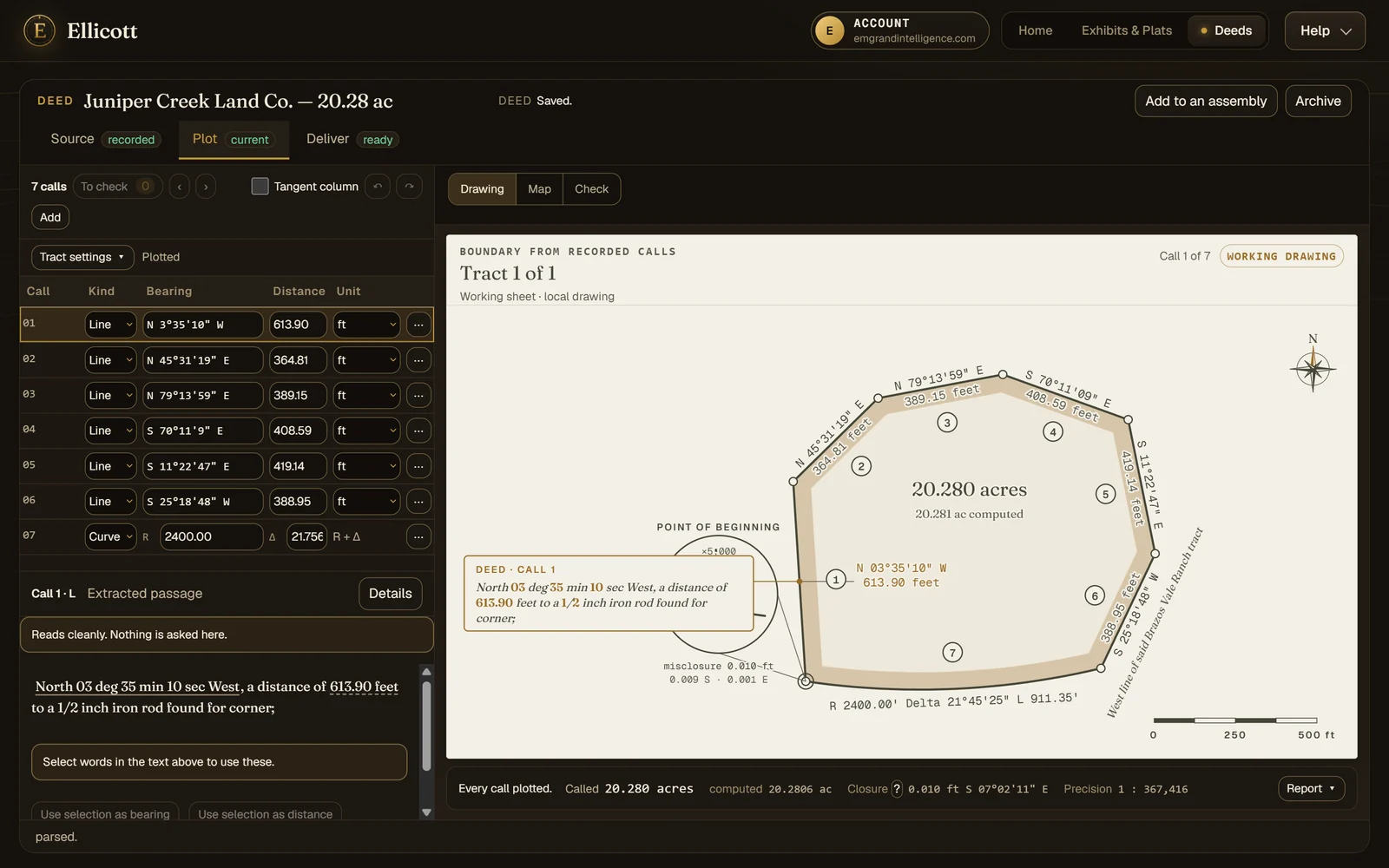
A demonstration deed: seven calls and a road-frontage curve, closing to 1 in 367,416.
One deed, a pair of swapped digits found and fixed on the page it came from, and the figure closing.
Each step keeps its evidence in view: the words a call came from, how far the figure misses closing, and where the tract sits on the ground.
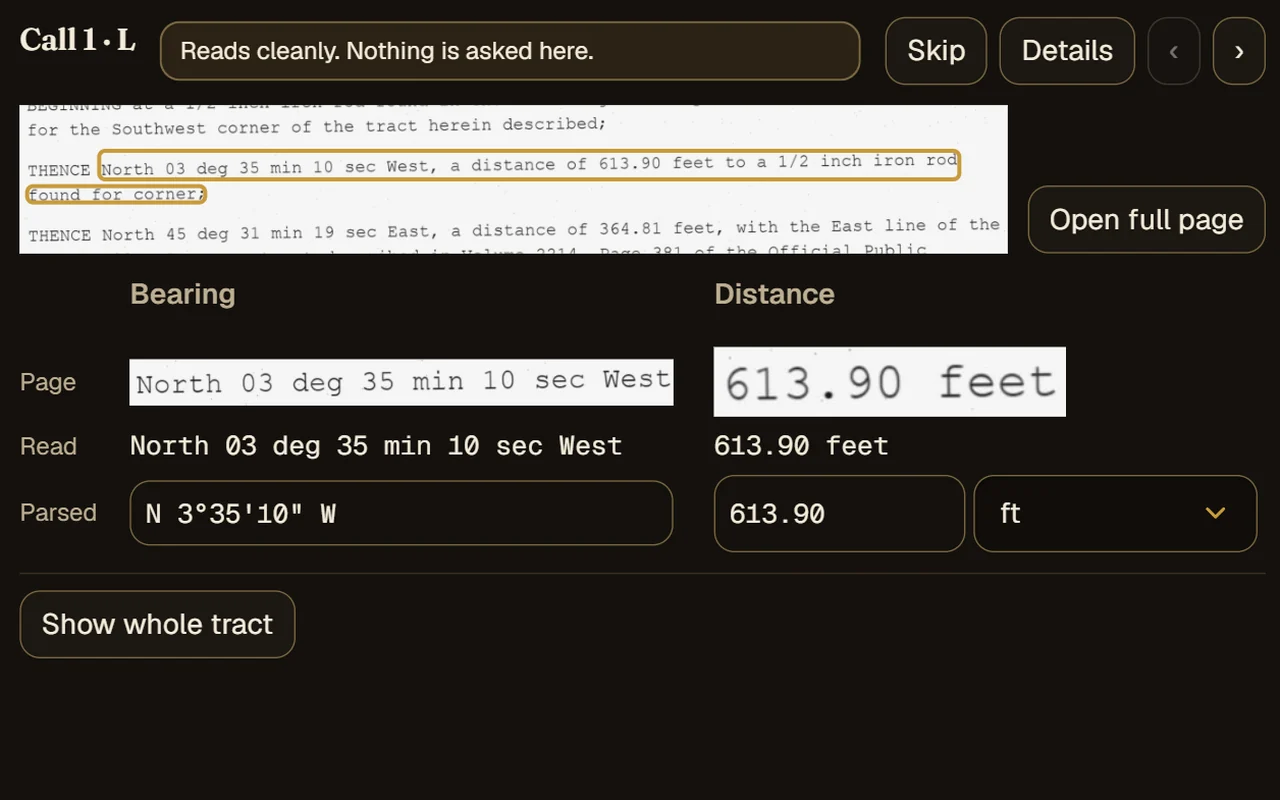
Drop in whatever the courthouse gave you. Scans and photos are read on our servers into a call table. For a scanned page, the Check view puts the page itself beside what was read and the value it became, so a misread is something you see rather than something you trust. A clean description often plots on the first read. A harder one stops at the call that needs you and says why, rather than drawing a guess.
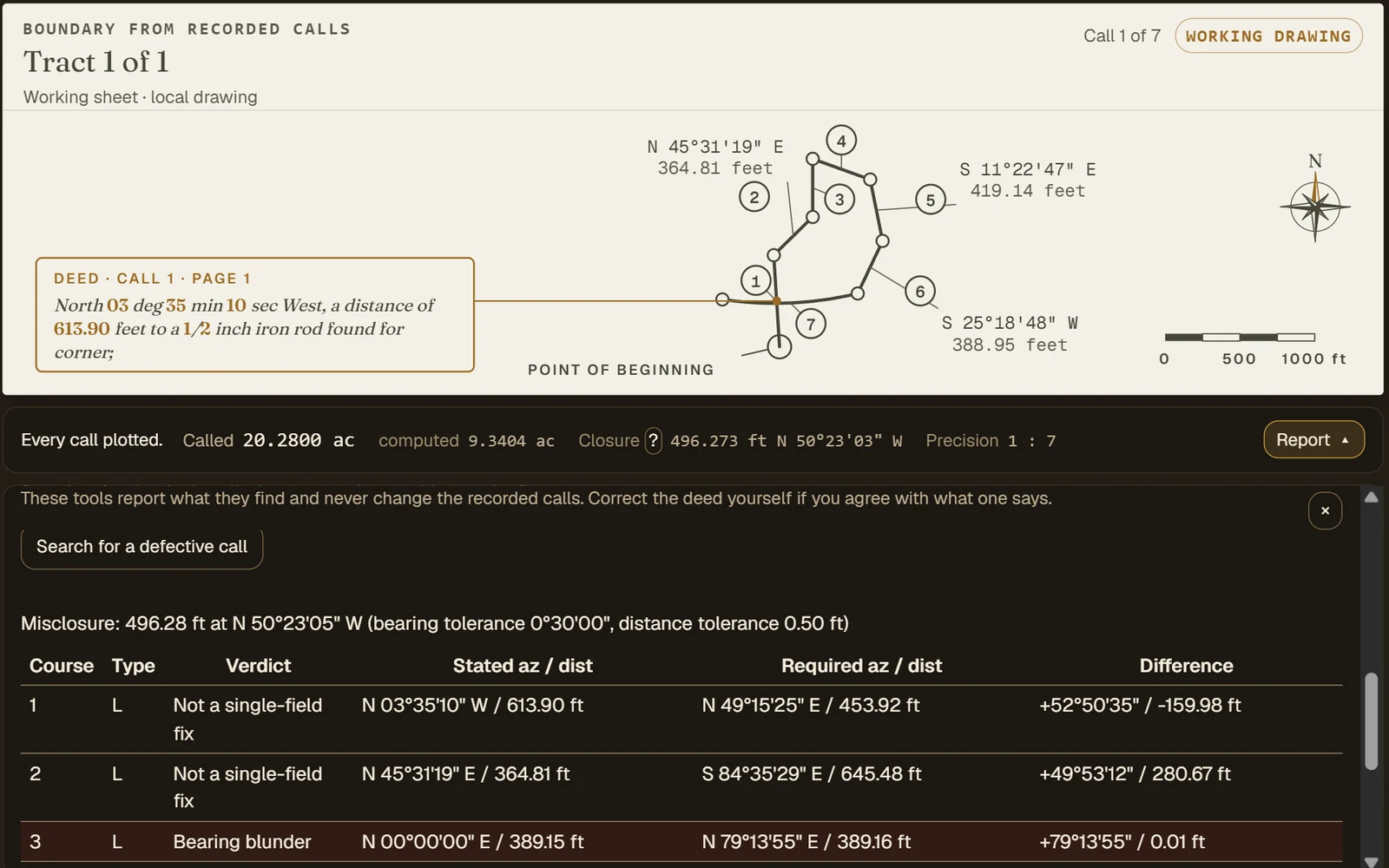
Closure error and direction, the precision ratio and the computed area against the deed's own acreage sit under the drawing the whole time. When a figure misses, the defective-call search looks for the single call whose bearing or distance would close it, and shows what that call would have to be. Not every deed closes as written: when no single call explains the miss, Ellicott says so and leaves the figure as the deed describes it, rather than forcing it shut. It reports; your calls only change when you change them. The Check tab compares each call with its page; the adjustments, ground-to-grid and defective-call search are under Report.
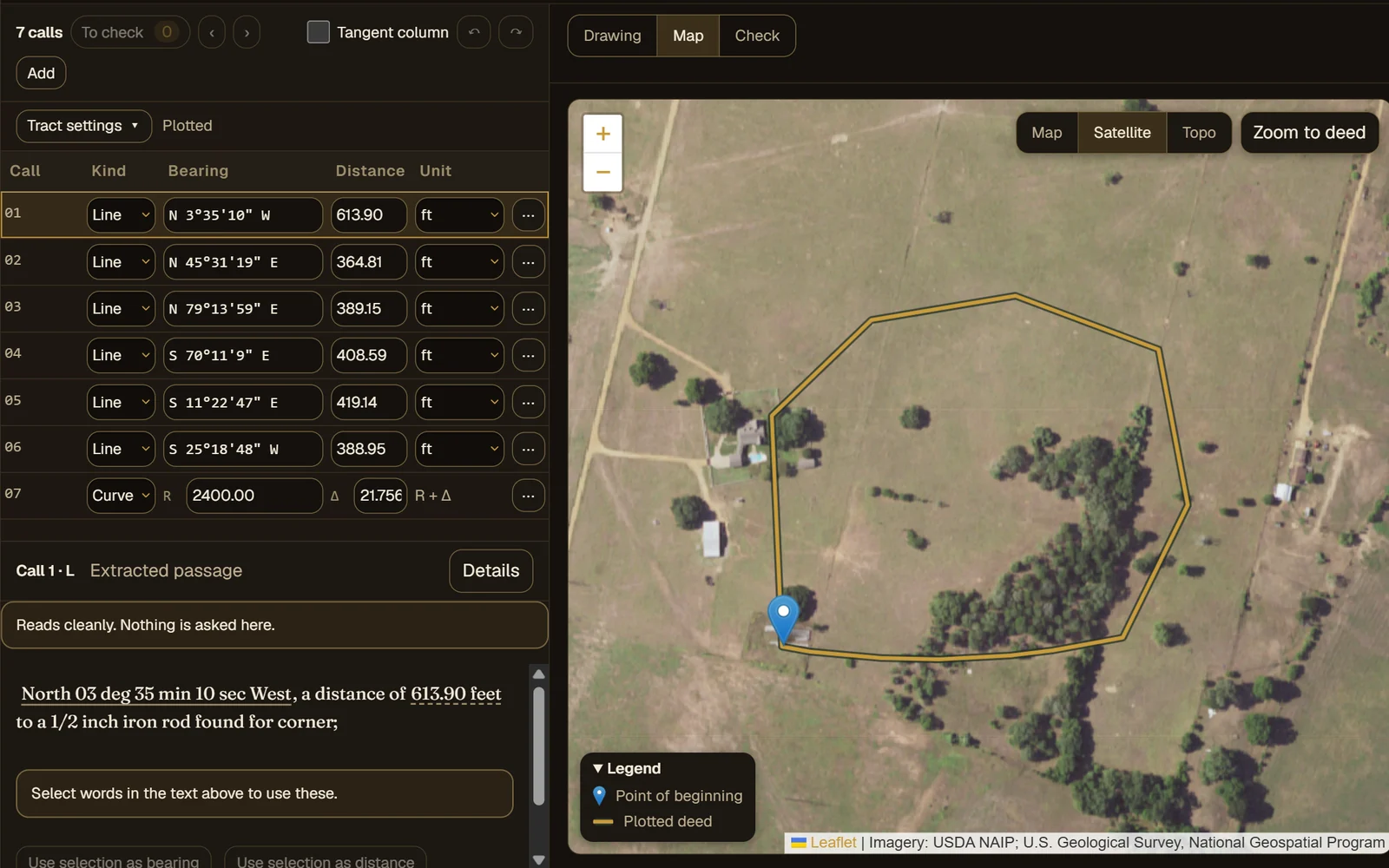
Set the point of beginning by clicking the map, typing coordinates, or taking the coordinates the deed itself states. Ellicott reads the county, survey and abstract out of the text to take you to the right place, then draws the tract in its state plane zone over aerial imagery.
Put neighboring deeds together, snap a corner to a corner or a line to a line, or fit a deed to found monuments with the rotation stated back to you. Then check every gap and overlap, with its area and the senior deed named.
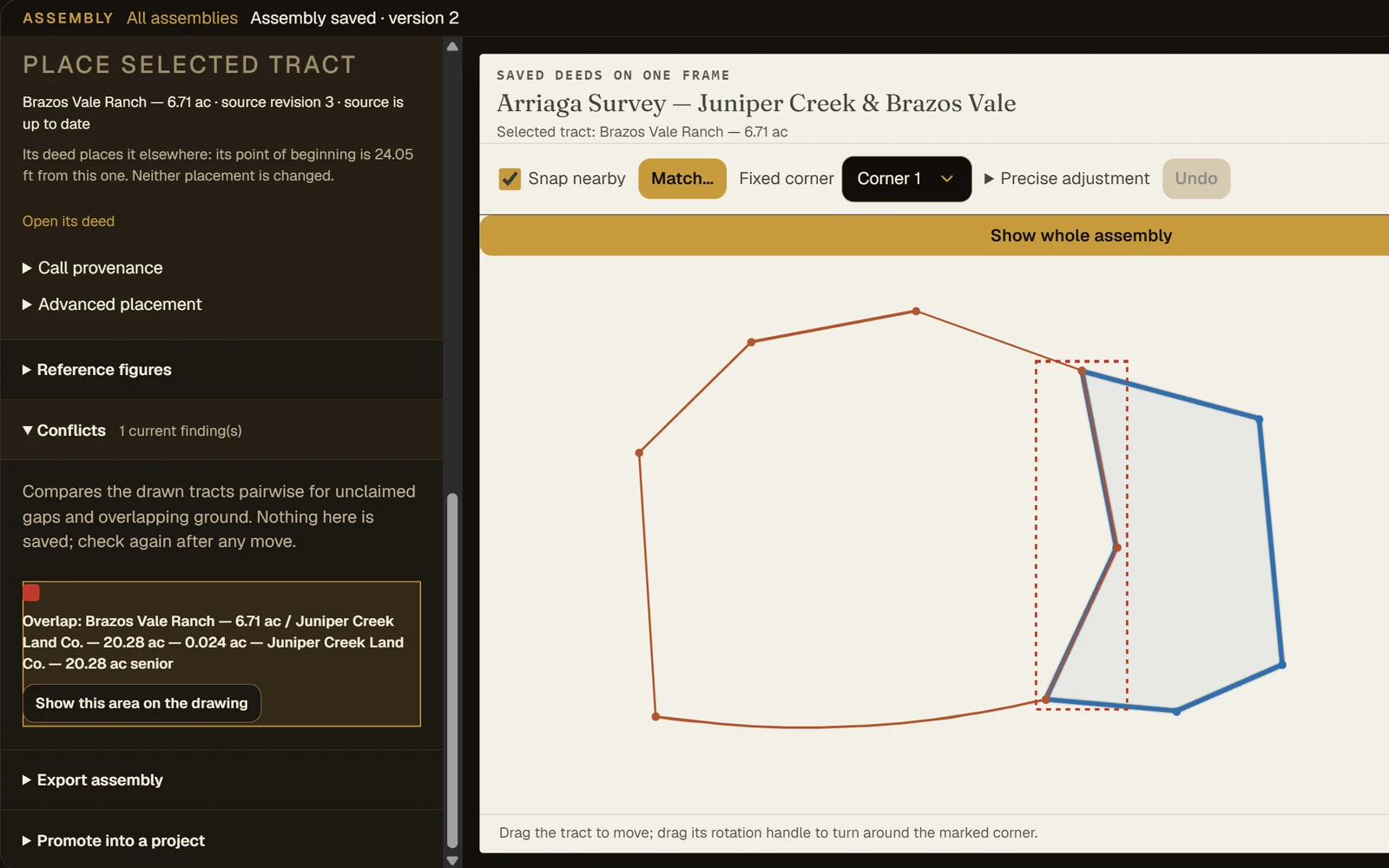
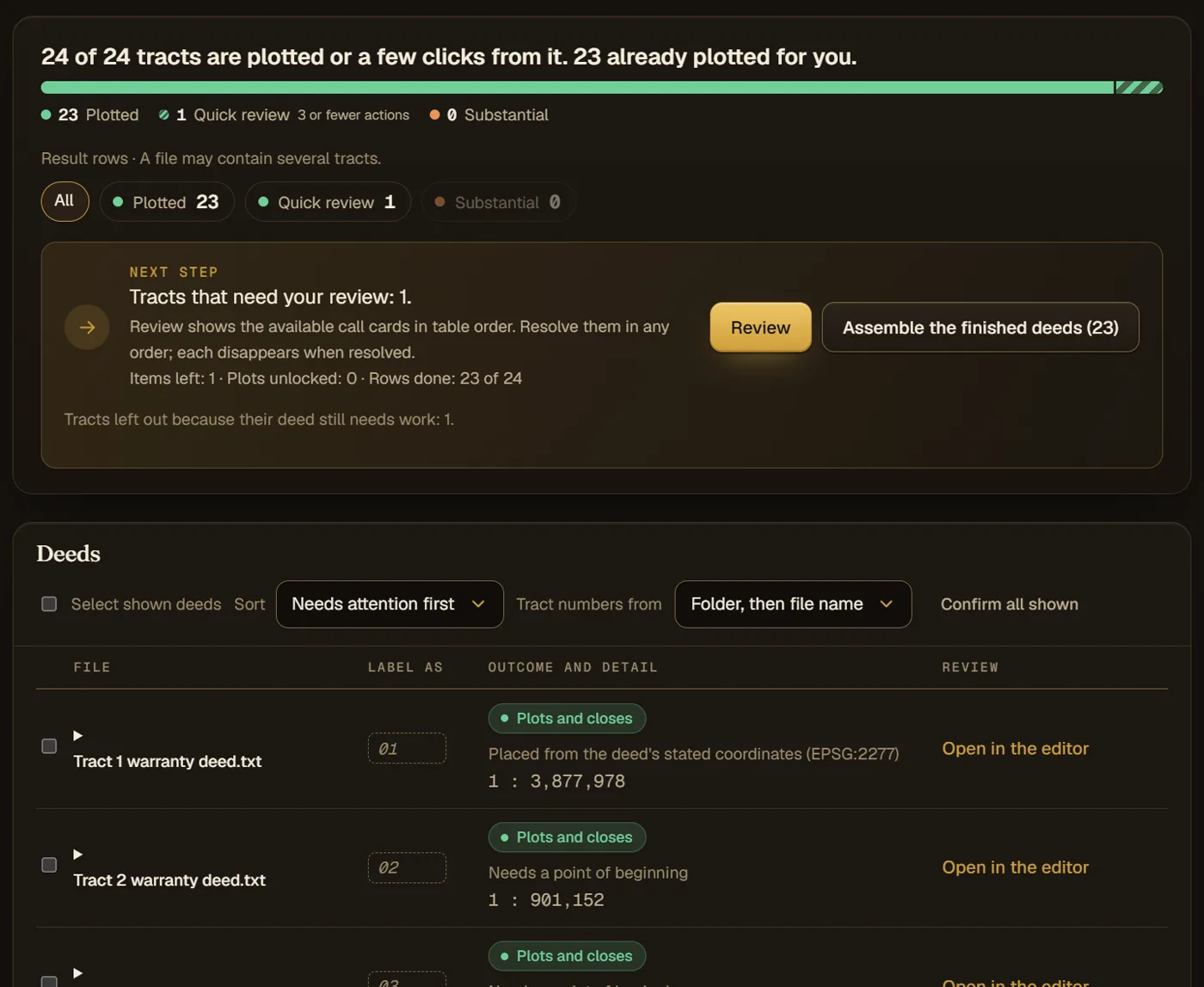
Drop a folder or a zip of deeds. Each file is read on its own, so one bad file never holds up the rest, and the results come back sorted by how much work each tract still needs: plotted, a quick review, or more. The one deed that needs you is the one you open.
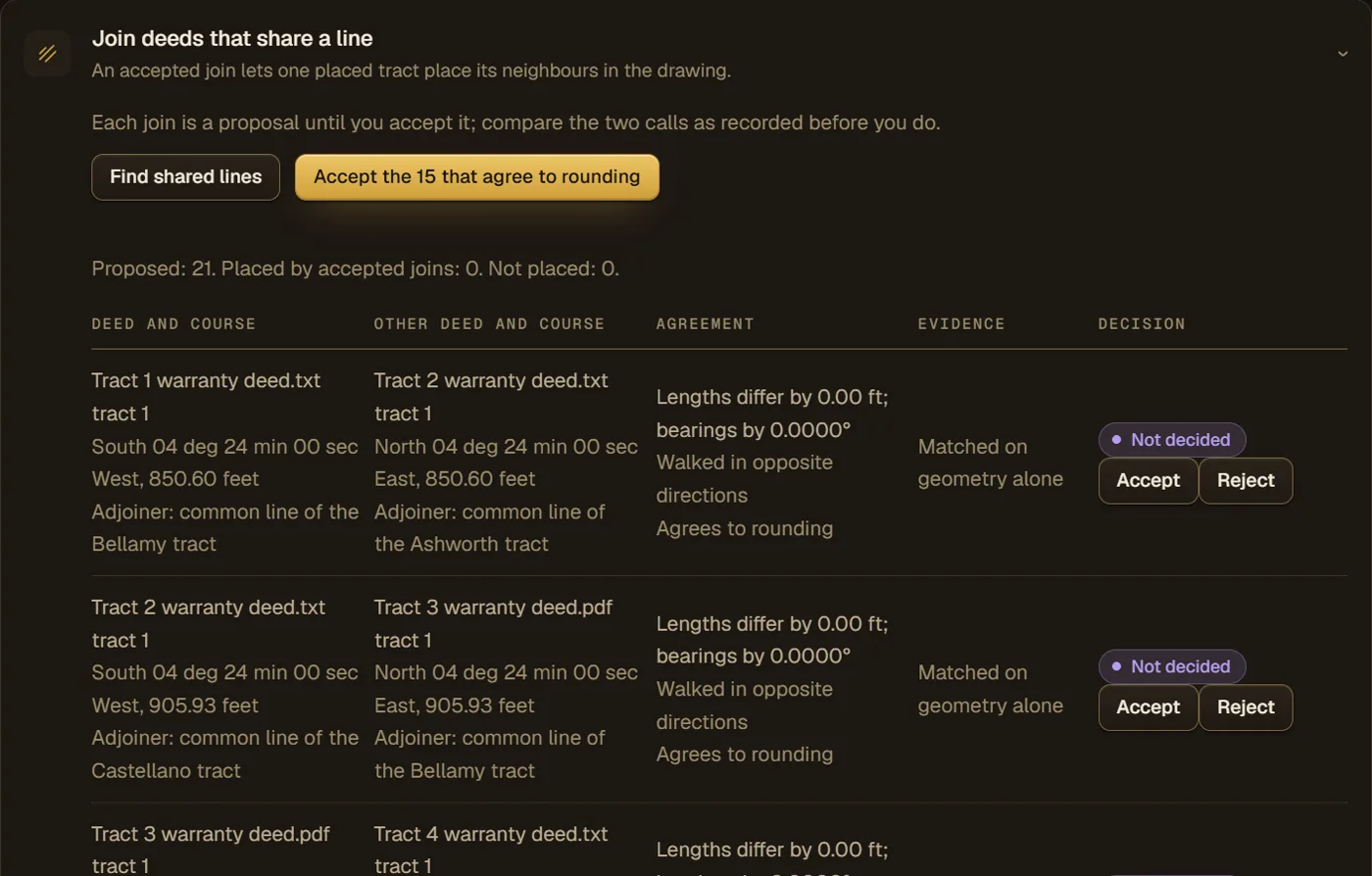
Ellicott finds the calls two deeds in a batch share and proposes each one as a join, with how far the two calls agree. Compare them as recorded, then accept or reject. An accepted join lets one placed tract place its neighbors.
Pick a preset for CAD, for GIS, or for the plat and the office, and deliver every deed that plots in one zip. With the CAD link set up, the package goes straight into the drawing you have open. One deed at a time, the same presets choose the format for you.
Send a crew one link to the monuments, ties and adjoiner corners a set of deeds call for, in each deed's own words, so nothing has to be printed. It is a record search aid: it carries no coordinates. Your surveyor gives the crew the coordinates they work to.
Six things worth asking of any tool that reads deeds, and what Ellicott does about each. Where it does not do something, the list says so.
Each number in the call table points back to the words it was read from. Where the deed is ambiguous, Ellicott flags the call and stops rather than choosing for you. Where it can offer a value the deed implies, the value carries a dagger mark (†) until you accept it, and a call read from a scan is not exported until you have checked it.
Deeds are read by recognition software on our own servers. They are never sent to an AI model or an outside service to be read.
Reading, plotting, checking and placing deeds cost nothing, and your first export is free. After that, buy one deed's export at a time, or take a plan for the office. A plan covers the office, not one computer.
$0
$49 per office, per month
$199 per month
See where it closes, and where it doesn't. No install, and your first export is free.